


Deciding between an Air Fryer vs Convection Oven often feels like a choice between two identical technologies, but the reality of your dinner’s texture depends on understanding what happens behind the oven door. While both appliances use fans to circulate heat, the way they manage airflow can mean the difference between a soggy potato and the ultimate golden crunch.
At AirFryer Go, we believe your kitchen tools should work as hard as you do. Whether you are a weekend baker with a large family or a busy professional looking for a 10-minute healthy meal, the “best” choice is the one that aligns with your daily rhythm. Let’s dive into the mechanical secrets and performance truths to help you discover which appliance truly earns its spot on your countertop.
>>> Read More: Best Air Fryer Oven Reviews: Top Countertop & French Door Models
Comparison Table: Air Fryer vs Convection Oven
A comparison table provides a clear side-by-side overview of the key differences between air fryers and convection ovens. From cooking speed and capacity to energy efficiency and ease of use, this table highlights the strengths and limitations of each appliance. Use it to determine which option best suits your cooking needs and kitchen setup.
| Feature | Air Fryer | Convection Oven |
| Design & Build | Compact, countertop-friendly | Larger, built-in or countertop models |
| Cooking Performance | Rapid air circulation for crispy results | Even heat distribution for versatility |
| Ease of Use & Cleaning | Simple controls, easy to clean | More features but requires more effort to clean |
| Price | Generally more affordable | Higher initial cost but larger capacity |
| Best For | Quick, oil-free meals | Versatile cooking for larger portions |
The Science of Air: How They Actually Work
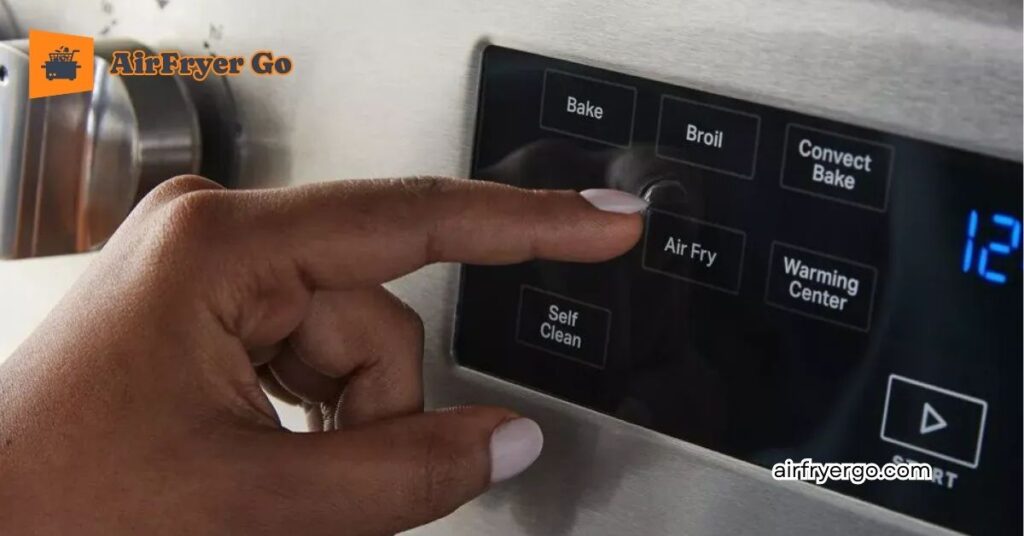
To understand why one appliance gives you a soft bake while the other delivers a shattering crunch, we have to look at the physics of moving air. At AirFryer Go, we simplify the science: it’s not just about the heat, it’s about the velocity.
Here is how these two machines manipulate air to cook your food.
1. Convection Oven: The Steady Stream
A convection oven is essentially a traditional oven with a “helper.” It features a heating element (usually at the bottom or top) and a fan located at the back of the oven cavity.
- The Process: The fan gently circulates hot air throughout the large interior. This movement breaks up “cold spots,” ensuring that the air temperature is uniform.
- The Airflow: Think of this as a gentle breeze. It is designed for evenness, making it perfect for delicate baking like cakes or large roasts that need to cook slowly and steadily.
- The Result: Consistent, even cooking, but with enough moisture retained that the exterior doesn’t become “fried.”
2. Air Fryer: The Concentrated Tornado
An air fryer is a compact, high-performance convection machine. Because the cooking chamber is much smaller, the physics change dramatically.
- The Process: A powerful heating element is positioned extremely close to the food (usually directly above the basket). Above that element is a high-speed, heavy-duty fan.
- The Airflow: This is a high-velocity tornado. Because the space is small, the air moves at a much higher speed than in a convection oven. This rapid movement strips moisture off the surface of the food almost instantly.
- The Maillard Reaction: This high-speed air triggers a rapid Maillard reaction (the chemical reaction between amino acids and reducing sugars) much faster than a standard oven could, creating that characteristic “fried” crust without the oil.
Expert Insight from AirFryer Go: This intensity is why air fryers often require you to lower your recipe’s temperature by about 25°F compared to a traditional oven. The air is so efficient at transferring heat that it can burn the outside before the inside is done if you aren’t careful.
Head-to-Head Comparison: The “AirFryer Go” Scorecard
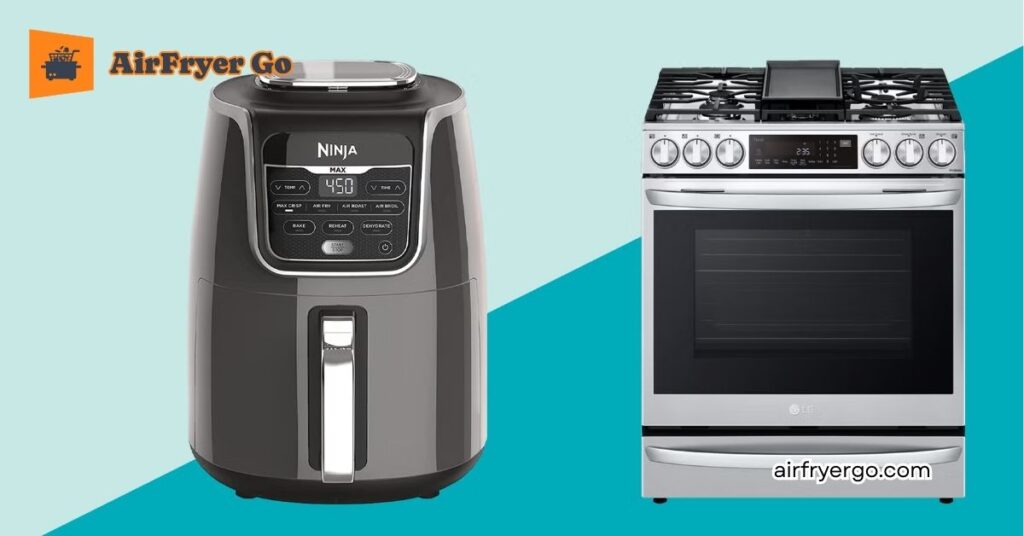
To help you settle the debate, we’ve put both appliances through a series of real-world kitchen tests. At AirFryer Go, we measure success by three main pillars: time, texture, and efficiency.
Here is how they stack up when the pressure is on and the kitchen is busy.
1. Time & Speed: The “Hungry Now” Test
In the world of modern cooking, speed is often the ultimate luxury.
- Air Fryer: Wins by a landslide. With little to no preheating required and a compact chamber, it can finish a batch of frozen snacks or roasted salmon in half the time of a traditional oven.
- Convection Oven: Requires 10–15 minutes just to reach temperature. While it cooks faster than a standard oven, it still lags behind the air fryer’s “instant-on” capability.
- Score: Air Fryer 1, Convection Oven 0
2. Texture & “The Crunch”: The Maillard Test
This is where the high-velocity science we discussed earlier meets the plate.
- Air Fryer: Delivers a shattering, dry crispiness that mimics deep frying. It’s the gold standard for wings, fries, and breaded proteins.
- Convection Oven: Excellent for “browning,” but rarely achieves a true “crunch.” It’s better for the soft-yet-firm texture of artisanal bread or a juicy prime rib.
- Score: Air Fryer 2, Convection Oven 0
3. Capacity & Volume: The “Big Family” Test
Speed doesn’t matter if you have to cook in four separate batches to feed everyone.
- Air Fryer: Limited. Even “XL” models struggle to cook a main and two sides at once. Overcrowding the basket leads to soggy food because the air can’t circulate.
- Convection Oven: The undisputed king. You can roast a 20lb turkey or bake three sheets of cookies simultaneously.
- Score: Air Fryer 2, Convection Oven 1
The Scorecard Summary
| Metric | Air Fryer | Convection Oven | Winner |
| Preheat Time | < 3 Minutes | 10+ Minutes | Air Fryer |
| Browning Quality | Intense / Crispy | Even / Golden | Tie (Depends on Goal) |
| Ease of Cleaning | Dishwasher Safe Baskets | Manual Scrubbing | Air Fryer |
| Batch Cooking | Small (1-3 people) | Large (4-8 people) | Convection Oven |
Final Note on Maintenance: Regardless of which one wins your heart, remember that efficiency drops when vents are clogged. As we always emphasize, keeping your fans clean and surveying your appliance’s condition annually is key to maintaining these performance scores.
>>> Read More: Air Fryer vs Oven: Which Is Better for Your Kitchen & Wallet?
Can a Convection Oven Be Used as an Air Fryer?
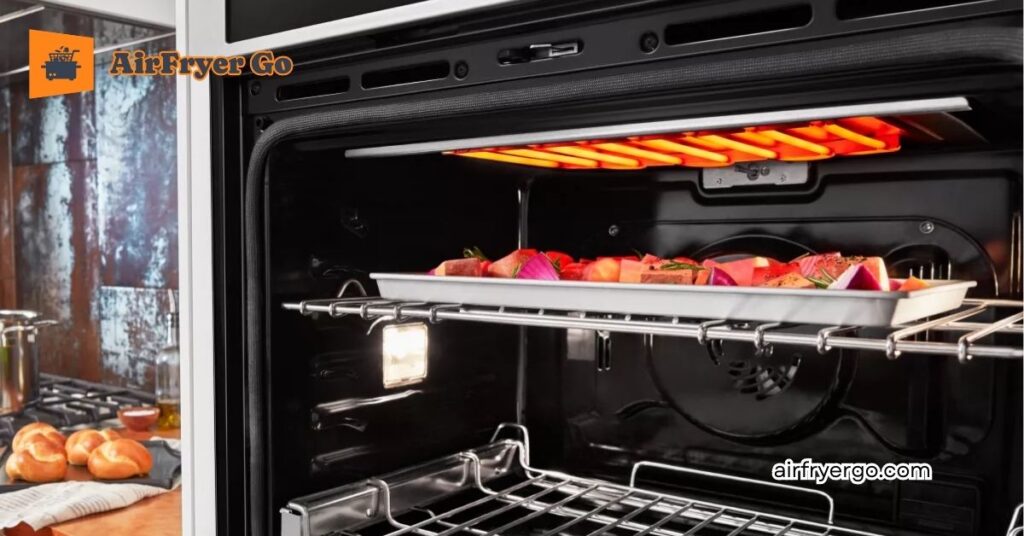
The main reason a convection oven doesn’t naturally “air fry” is the sheer volume of space. In an air fryer, the air hits the food with the force of a gale; in an oven, it’s more like a summer breeze. To fix this, you need to change how you prep and position your food.
1. The Equipment Hack: Use a Perforated Tray
If you place your food on a solid baking sheet, the air can only hit the top. To mimic an air fryer, you must allow air to reach the bottom of the food.
- The Fix: Use a dark, mesh-style “air fry tray” or place a wire cooling rack inside your baking sheet. This elevates the food, allowing the convection fan to circulate heat 360 degrees around each piece.
2. The Temperature Rule: The 25° Rule
Air fryers are more intense. If a recipe is written for a standard oven, an air fryer usually requires a lower temperature. If you are doing the opposite—trying to “air fry” in a convection oven—you actually need to ensure your oven is truly at the target heat before the food goes in.
- The Fix: Always preheat your convection oven for at least 15 minutes. While the air fryer is “instant,” the oven needs time to heat the heavy interior walls to help maintain consistent energy.
3. Don’t Overcrowd the “Real Estate”
In a dedicated air fryer, we always say “don’t stack.” In a convection oven, this is even more critical. Because the fan is further away, any overlap in food will result in steam rather than a crisp.
- The Fix: Leave at least an inch of space between every chicken wing or potato wedge.
Is Convection Bake the Same as Air Fry?

The main reason a convection oven doesn’t naturally “air fry” is the sheer volume of space. In an air fryer, the air hits the food with the force of a gale; in an oven, it’s more like a summer breeze. To fix this, you need to change how you prep and position your food.
1. The Equipment Hack: Use a Perforated Tray
If you place your food on a solid baking sheet, the air can only hit the top. To mimic an air fryer, you must allow air to reach the bottom of the food.
- The Fix: Use a dark, mesh-style “air fry tray” or place a wire cooling rack inside your baking sheet. This elevates the food, allowing the convection fan to circulate heat 360 degrees around each piece.
2. The Temperature Rule: The 25° Rule
Air fryers are more intense. If a recipe is written for a standard oven, an air fryer usually requires a lower temperature. If you are doing the opposite—trying to “air fry” in a convection oven—you actually need to ensure your oven is truly at the target heat before the food goes in.
- The Fix: Always preheat your convection oven for at least 15 minutes. While the air fryer is “instant,” the oven needs time to heat the heavy interior walls to help maintain consistent energy.
3. Don’t Overcrowd the “Real Estate”
In a dedicated air fryer, we always say “don’t stack.” In a convection oven, this is even more critical. Because the fan is further away, any overlap in food will result in steam rather than a crisp.
- The Fix: Leave at least an inch of space between every chicken wing or potato wedge.
Decision Guide: Which One Should You Buy?

Choosing between these two powerhouses isn’t about which technology is “better”—it’s about which one fits the way you eat and the space you have. At AirFryer Go, we’ve simplified the decision-making process into four distinct categories.
Find the profile that matches you best to see where you should invest your money.
1. The “Need-It-Now” Professional
- Your Lifestyle: You get home late, you’re often cooking for one or two, and you rely on frozen staples or quick-roast proteins like salmon and chicken breasts.
- The Recommendation: Standalone Air Fryer.
- Why: You can’t beat the 0-minute preheat time. It’s faster, easier to clean, and delivers a superior “crunch” for small portions that a large oven simply can’t match.
2. The Family Feast Coordinator
- Your Lifestyle: You’re cooking for a household of 4+, you do weekly meal prep, or you love hosting Sunday roasts and holiday dinners.
- The Recommendation: Full-Size Convection Oven.
- Why: You need “real estate.” An air fryer basket is too small for a family-sized batch of fries, leading to multiple rounds of cooking. A convection oven lets you finish everything at once.
3. The Apartment Minimalist
- Your Lifestyle: You have very limited counter space but want the ability to bake occasionally and air fry often.
- The Recommendation: Air Fryer Toaster Oven (The Hybrid).
- Why: This is the perfect middle ground. It replaces your toaster, your small oven, and your air fryer in one footprint. While it takes slightly longer to crisp than a basket-style unit, its versatility is unmatched for small kitchens.
4. The Health-Conscious Gourmet
- Your Lifestyle: You prioritize texture and flavor but want to eliminate deep-frying. You’re willing to trade a bit of counter space for the best possible culinary result.
- The Recommendation: High-Velocity Basket Air Fryer.
- Why: For a true “fried” experience without the oil, the concentrated tornado of air in a basket-style fryer is the only way to go. Even the best convection oven will feel a bit “lackluster” by comparison.
Expert Tip: Pricing for these units can vary significantly based on brand and seasonal sales. As a reminder, we suggest surveying the latest models and checking for refurbished options from reputable brands—this can often get you a premium convection or air fryer unit for a fraction of the cost.
>>> Read More: Air Fryer: Is It Worth It? A Brutally Honest Guide to Pros & Cons
Frequently Asked Questions (FAQs)
1. Why is my air fryer so much faster than my convection oven?
It comes down to size and fan power. A convection oven has to heat a massive cavity (usually 3–5 cubic feet), which takes time. An air fryer is a compact chamber where the fan is much closer to the heating element and the food. This creates a “wind chill” effect—but with heat—that transfers energy much more efficiently.
2. Do I really need an air fryer if my oven already has a convection setting?
If you are happy with “oven-baked” results, then no. However, if you want your food to have a shattering, fried-like crunch, your standard convection oven likely won’t satisfy you. The fan speed in most ovens isn’t high enough to mimic the “frying” effect that a dedicated air fryer provides.
3. Can I put multiple racks in an air fryer like I do in a convection oven?
Generally, no. Most basket-style air fryers rely on vertical airflow. If you stack food or use multiple racks, the top layer will burn while the bottom stays soggy. If you need to cook on multiple levels, a Convection Oven or an Air Fryer Toaster Oven with specialized shelving is a better choice.
4. Is an air fryer healthier than a convection oven?
Both are significantly healthier than deep-frying because they use air instead of oil. However, because an air fryer is more efficient at crisping, you often don’t need any oil to get a good result. In a convection oven, you might find yourself adding a bit more oil to help the food brown properly in the larger space.
5. Can I bake a cake in an air fryer?
Yes, but you have to be careful. Because the heat is so intense and the fan is so powerful, the outside of the cake can “set” and burn before the middle is cooked. You’ll need to lower the temperature by 25°F – 50°F and potentially cover the top with foil. For delicate baking, the Convection Oven is still the superior tool.
Conclusion: Final Verdict
Choosing between an Air Fryer vs. Convection Oven isn’t about finding the “better” technology—it’s about choosing the right airflow for your lifestyle. As we’ve explored, the “science of air” dictates that while they share a similar DNA, their performance in your kitchen will be worlds apart.
If you are a busy individual or a small household craving that “shattering crunch” in record time, the Air Fryer is your undisputed champion. However, if you are the heart of a large family who values the versatility of multi-tray baking and grand holiday roasts, the Convection Oven remains the king of the kitchen.
At AirFryer Go, our goal is to help you navigate these technical nuances so you can cook with confidence. We believe that when you understand the “why” behind your appliances—from fan speeds to heat proximity—you unlock the ability to make every meal a success.
Recommended next reads:
Microwave vs. Air Fryer: Which One Do You Actually Need?
Air Fryer vs Instant Pot: Which Multi-Cooker is Right for You?
Air Fryer vs Deep Fryer: Is the Healthier Choice Actually Tastier?


