


The debate of air fryer vs oven often starts at the kitchen counter, usually when you are staring at a large, cold appliance and wondering why a simple weeknight dinner has to take 45 minutes. For years, the conventional oven has been the reliable anchor of our kitchens, but the rise of rapid air technology has forced many of us to rethink how we use our cooking space and our time.
At AirFryer Go, we understand that a kitchen tool is only as good as the life it makes easier. You shouldn’t have to choose between a perfectly roasted meal and your precious evening hours. Whether you are looking to reclaim your countertop or simply want to know if that “crunch” is worth the extra plug, let’s peel back the layers of marketing to see which appliance truly fits your daily rhythm and your appetite.
>>> Read More: Best Air Fryer Oven Reviews: Top Countertop & French Door Models
Comparison Table: Air Fryer vs Oven
Easily compare the key differences between an air fryer and an oven with this detailed table. From cooking speed to energy efficiency, discover which appliance is better suited for your kitchen needs.
| Feature | Air Fryer | Oven |
| Design & Build | Compact, countertop-friendly, often portable | Larger, built-in or freestanding |
| Cooking Performance | Rapid air circulation for crispier results | Consistent baking and roasting |
| Ease of Use | Simple presets, easy cleaning | More options but longer cleanup |
| Price Range | $50–$300 | $200–$2000+ |
| Best For | Quick meals, small batches | Larger meals, versatile cooking |
The Core Difference: How They Heat Your Food

To understand the results on your plate, you first have to understand the invisible dance of heat inside the machine. At AirFryer Go, we like to say that the most significant difference in the air fryer vs oven battle isn’t the temperature you set—it’s how that heat travels to your food.
Here is the breakdown of the “Radiator” vs. the “Turbo-Charger.”
1. The Conventional Oven: Radiant Soaking
Think of a traditional oven like a warm sauna. It uses heating elements (usually at the top and bottom) to heat the air inside the large stone or metal box.
- The Process: Once the air reaches the set temperature, it sits relatively still. The heat “soaks” into your food from the outside in.
- The Physics: This is a slow, gentle process. Because the air isn’t moving aggressively, moisture stays trapped inside the food longer.
- Best For: This is why the oven is the gold standard for baking. It allows bread to rise and cakes to stay moist without the surface drying out too quickly.
2. The Air Fryer: Convective Blasting
An air fryer is essentially a high-intensity wind tunnel. It’s not just an oven; it’s an engine.
- The Process: A powerful fan is located directly above a concentrated heating element. Instead of letting the hot air sit, the fan blasts it downward and around the food at incredible speeds.
- The Physics: This high-velocity air creates a “wind chill” effect in reverse—stripping moisture off the surface of your food almost instantly. This is what creates that “fried” crust using only air.
- Best For: Achieving the Maillard Reaction (the chemical reaction that browns food) in record time. It’s the king of frozen fries, crispy chicken wings, and roasted vegetables.
Head-to-Head Comparison: Performance Truths

In the battle of air fryer vs oven, marketing claims often cloud the reality of daily cooking. At AirFryer Go, we’ve put both to the test to see how they perform when the kitchen gets busy. Here are the “Performance Truths” that will actually impact your dinner table.
1. Speed & Convenience: The “Hungry Now” Factor
We live in a world where every minute counts. This is where the air fryer shows its true strength.
- The Preheat Penalty: A conventional oven is like a large ship—it takes a long time to turn on and heat up. You’ll often wait 15 minutes just to reach $400^{\circ}\text{F}$.
- The Air Fryer Advantage: Because the chamber is small and the airflow is intense, most air fryers reach cooking temperature in under 3 minutes.
- The Result: For quick snacks or mid-week proteins, the air fryer can have food on your plate before the oven has even finished preheating.
2. Texture & Quality: Crunch vs. Consistency
The difference between air fryer and baking becomes very clear when you take your first bite.
- Air Fryer (The Crunch King): If you love the texture of fried wings, Brussels sprouts, or French fries, the air fryer is superior. The rapid moisture evaporation creates a “shattering” crispiness that a conventional oven simply cannot replicate.
- Oven (The Baking Master): For items that require a gentle, even rise—like a delicate soufflé, a tray of chewy brownies, or a large loaf of bread—the oven is irreplaceable. The air fryer’s fan is often too powerful for these, causing the tops to crack or fly off.
3. Capacity & Volume: Feeding the Crowd
This is where the conventional oven makes its comeback.
- Air Fryer: Most baskets are designed for 1–3 people. If you try to crowd the basket to feed a family of five, the air cannot circulate, and you’ll end up with soggy, unevenly cooked food.
- Conventional Oven: You can cook a 20lb turkey, two trays of roasted potatoes, and a casserole all at once. For holiday hosting or large-family meal prepping, the oven is the undisputed winner.
The AirFryer Go Performance Scorecard
| Feature | Air Fryer | Conventional Oven | Winner |
| Preheat Speed | Instant – 3 Mins | 15+ Mins | Air Fryer |
| Crispiness Level | Professional Crunch | Golden/Soft | Air Fryer |
| Cooking Capacity | Small (1-3 people) | Large (4-8+ people) | Oven |
| Ease of Cleaning | Dishwasher Safe | Manual Labor | Air Fryer |
Expert Insight: Efficiency is only as good as the appliance’s condition. A dirty oven heating element or a grease-clogged air fryer fan will force the machine to work harder, increasing your costs. We recommend a quick survey of your appliance’s cleanliness once a month to keep these performance truths in your favor.
>>> Read More: Air Fryer or Convection Oven: Which One Should You Choose?
The “Hidden” Costs: Energy & Space

Beyond the price tag on the box, every appliance carries “hidden” costs that affect your monthly bills and your kitchen’s flow. At AirFryer Go, we look past the shiny exterior to see how the air fryer vs oven debate impacts your wallet and your workspace over time.
1. Electricity Usage: The Battle of the Bill
One of the most common questions we hear is: “Does a small air fryer actually save money on electricity?” The answer lies in the math of time versus power.
- The Oven’s Heavy Draw: A typical conventional oven pulls between 2,000 and 5,000 watts. Because of its massive size, it stays “on” much longer to maintain heat, especially during that 15-minute preheat cycle.
- The Air Fryer’s Efficiency: Most air fryers draw between 1,400 and 1,700 watts. While the wattage is high, the duration is short. By skipping the long preheat and cooking 25% faster, an air fryer can reduce the energy used for a single meal by up to 50% compared to a large oven.
- The Verdict: For daily meals for 1-2 people, the air fryer is the clear economic winner. However, if you have to run three separate “batches” in an air fryer to feed a family, you are better off using the oven once.
2. The “Space Tax”: Countertop vs. Built-in
Kitchen real estate is often more valuable than money.
- The Oven (Invisible Footprint): Since most ovens are built-in (under the counter or in the wall), they don’t take up your “working” space. They are always there, ready for big tasks.
- The Air Fryer (The Countertop Guest): An air fryer is a “space hog.” It requires a flat surface and—crucially—at least 5 inches of clearance from the wall to vent hot air safely.
- AirFryer Go Tip: If you have a tiny kitchen, consider an Air Fryer Toaster Oven. It replaces your toaster and your air fryer, saving you from “appliance creep.”
3. The “Hidden” Climate Cost: Kitchen Heat
Have you ever tried to bake cookies in the middle of July?
- Conventional Oven: Acts like a giant radiator. It can raise the temperature of your kitchen by several degrees, forcing your Air Conditioning to work harder and increasing your cooling costs.
- Air Fryer: It is well-insulated and compact. It exhausts a small amount of heat quickly, keeping your kitchen (and you) cool while you cook.
| The “Cost” Factor | Air Fryer | Conventional Oven |
| Energy Impact | Low (Fast/Efficient) | High (Slow/Large volume) |
| Kitchen Heat | Minimal | Significant |
| Prep Space | Takes up counter space | Built-in / Out of the way |
| Maintenance | Frequent basket washing | Occasional deep scrubbing |
Expert Survey Reminder: At AirFryer Go, we always remind our readers that your home’s electrical health is paramount. Before adding a high-wattage air fryer to a kitchen that already runs a microwave and a dishwasher, ensure your circuits can handle the load. A quick survey of your kitchen’s power capacity can prevent a tripped breaker during dinner.
Baking vs. Air Frying: Can One Replace the Other?

This is the ultimate question for many home cooks: If I buy one, do I still need the other? While the terms are often used interchangeably, the difference between air fryer and baking is a matter of culinary physics. At AirFryer Go, we’ve tested everything from soufflés to sourdough to see if one appliance can truly “do it all.”
1. The Science of the “Rise”
Baking is a delicate balance of heat and moisture.
- The Oven (The Baking Specialist): In a conventional oven, the heat is steady and the air is relatively still. This allows cakes, muffins, and breads to rise evenly. The moisture stays inside the batter long enough for the structure to set perfectly.
- The Air Fryer (The Surface Specialist): The air fryer’s fan is often too aggressive for “wet” batters. It can blow the top of a cake to one side or dry out the crust before the middle has even begun to rise.
- The Verdict: You can bake in an air fryer, but the oven remains the king of precision for delicate pastries.
2. The “Replacement” Hack: Converting Recipes
Can one replace the other for daily meals? Yes, provided you know the math. Because an air fryer is a concentrated wind tunnel, it cooks much more intensely than a baking sheet in an oven.
If you are following an oven baking recipe but using an air fryer, follow the AirFryer Go 25/20 Rule:
- Reduce Temperature by 25 F.
- Reduce Cooking Time by 20% to 30%.
3. Where Each One Wins
| Scenario | Use the Oven for… | Use the Air Fryer for… |
| Large Batches | 24+ Cupcakes / 3 Pizzas | 1-2 Servings / Reheating |
| Texture Goal | Soft, Chewy, Airy | Crispy, Crunchy, Seared |
| Delicate Foods | Soufflés, Custards, Tiered Cakes | Wings, Veggies, Frozen Snacks |
| Reheating | Never (Dries food out) | Always (Restores the crunch) |
For minimalists, students, or couples, the answer is often yes. If you rarely roast whole turkeys or bake multi-tiered cakes, a high-quality air fryer (or an air fryer toaster oven) can handle 90% of your daily needs.
However, for the serious baker or the “big meal” host, the air fryer is an accessory, not a replacement. It handles the side dishes (like crispy Brussels sprouts) while the oven handles the main event (the lasagna or the roast).
Decision Guide: What Should You Choose?
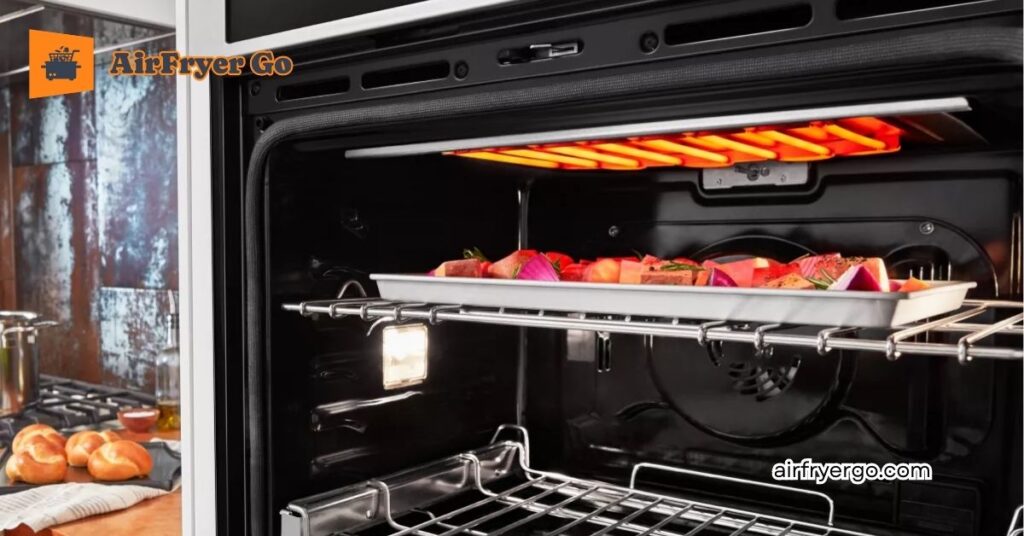
Choosing the right appliance isn’t about finding the “best” technology; it’s about matching a machine to your daily rhythm. At AirFryer Go, we believe your kitchen should work for you, not the other way around.
To help you decide between the air fryer versus oven, find the profile below that best describes your lifestyle.
1. The “On-The-Go” Professional
- Your Lifestyle: You value sleep and downtime. You often cook for one or two, and you need dinner ready in the time it takes to change out of your work clothes.
- The Choice: Basket-Style Air Fryer.
- Why: You can’t beat the “instant-on” nature. It’s perfect for reheating leftovers so they taste fresh, or crisping up a quick protein and veg combo in under 15 minutes.
2. The Sunday Feast Coordinator
- Your Lifestyle: You are the heart of the home. You cook in bulk, love hosting holidays, or have a family of four or more who all want to eat at the same time.
- The Choice: Conventional Oven.
- Why: You need “Real Estate.” An air fryer is too small to handle a full tray of lasagna or a dozen chicken thighs without overcrowding. The oven ensures everything is hot and ready at the same moment.
3. The Health-Conscious Foodie
- Your Lifestyle: You love the taste of “fried” food but want to avoid the calories of deep-frying. You prioritize texture and aren’t afraid to experiment with new recipes.
- The Choice: High-Velocity Air Fryer.
- Why: Even with a convection setting, a conventional oven rarely achieves that “shattering” crunch. If texture is your priority, the air fryer is your best friend.
4. The Small-Space Minimalist
- Your Lifestyle: You live in a studio or an apartment with limited counter space. You want the best of both worlds without owning two separate machines.
- The Choice: Air Fryer Toaster Oven (The Hybrid).
- Why: It replaces your toaster, your small oven, and your fryer. While it might take a few minutes longer to crisp than a basket model, its versatility is unmatched for small kitchens.
>>> Read More: Air Fryer: Is It Worth It? A Brutally Honest Guide to Pros & Cons
Frequently Asked Questions (FAQs)
1. Is air frying really healthier than baking in a conventional oven?
Strictly speaking, both methods use dry heat and are healthier than deep-frying. However, the air fryer often wins because its high-speed fan is so efficient at crisping that you can achieve a “fried” texture with zero oil. In a conventional oven, you often need to add a bit more oil or butter to help the food brown properly in the larger, slower-moving air.
2. Can I use aluminum foil or parchment paper in both?
- In an Oven: Yes, absolutely. It is a standard practice to line baking sheets.
- In an Air Fryer: Yes, but with a warning. You must never put foil or paper in an air fryer without food on top to weigh it down. The powerful fan can blow the paper into the heating element, creating a fire hazard. Also, avoid covering the entire basket—the air needs those holes to circulate!
3. Why does my food dry out in the air fryer but stay juicy in the oven?
This is the difference between air fryer and baking in action. The air fryer’s “tornado” of air evaporates moisture very quickly. If you cook lean meats (như ức gà) for too long at a high temperature, they will dry out.
- The Fix: Use the “25/20 Rule”—lower the temperature and shorten the time compared to your oven settings.
4. Can I put a glass baking dish in an air fryer?
Generally, if a dish is “Oven Safe,” it is safe for an air fryer. However, we recommend metal or silicone. Glass can block the airflow significantly in a small basket, and the rapid temperature changes in an air fryer can sometimes put stress on glassware.
5. If I have a “Convection” setting on my oven, do I still need an air fryer?
This depends on your “crunch” standards. A convection oven is a great “all-rounder,” but it’s like a passenger car—steady and reliable. An air fryer is a race car—built for speed and intensity. If you want professional-level crispiness on your wings and fries, the convection oven will likely leave you wanting more.
Final Verdict: The AirFryer Go Recommendation
The debate between the air fryer vs oven isn’t about finding a universal winner; it’s about finding the “champion” that fits your unique culinary rhythm.
If you are a busy professional who values every minute of downtime and craves that perfect, healthy crunch for quick meals, the air fryer is the modern revolution your kitchen deserves. However, if your kitchen is a place for slow-baked masterpieces, artisanal breads, or hosting large family gatherings, the conventional oven remains an irreplaceable anchor.
At AirFryer Go, we believe the smartest investment starts with understanding your own needs. You don’t necessarily have to choose one over the other—when used together, they create a powerful ecosystem that handles everything from the smallest snack to the grandest feast.
Recommended next reads:
Microwave vs. Air Fryer: Which One Do You Actually Need?
Air Fryer vs Instant Pot: Which Multi-Cooker is Right for You?
Air Fryer vs Deep Fryer: Is the Healthier Choice Actually Tastier?


