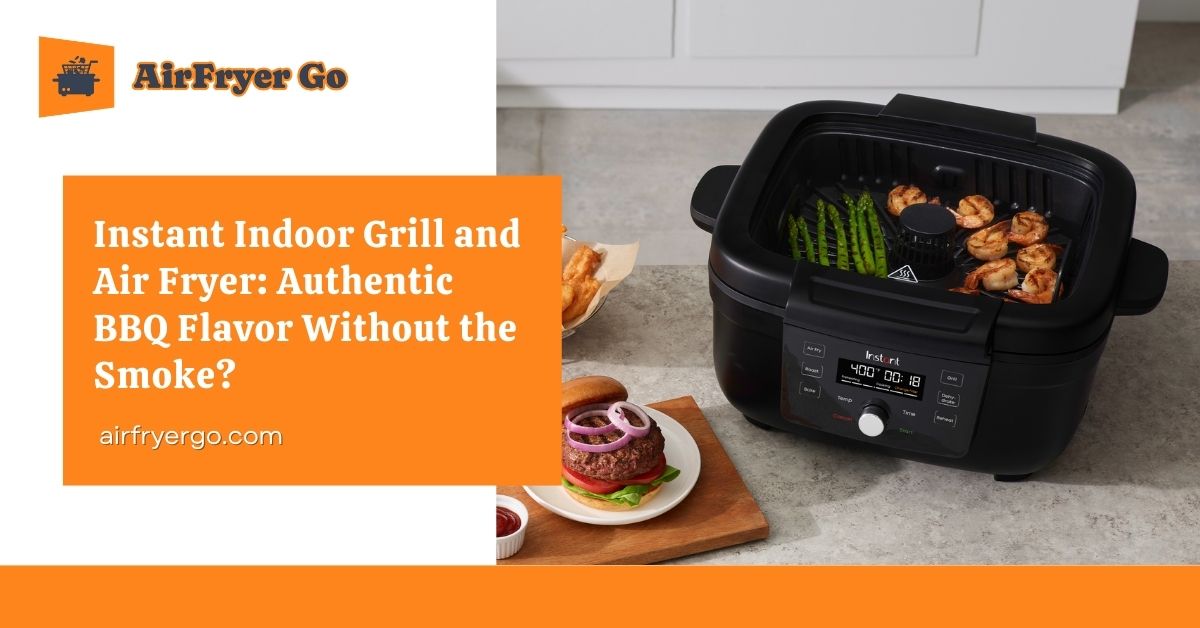
Finding the perfect instant indoor grill and air fryer is often the final piece of the puzzle for apartment dwellers who refuse to compromise on that authentic, flame-seared flavor. Most hybrid appliances promise the “best of both worlds,” but few can actually generate the 510°F sear required to mimic an outdoor charcoal pit while simultaneously delivering the convection power for golden, crispy fries.
We took this versatile machine into our test kitchen to see if its carbon-filter technology and heavy-duty grill plate truly deliver a backyard BBQ experience without the backyard—or the mess.
>>> Read More: Best Air Fryer Reviews For Year: Top-Rated Picks for Every Kitchen & Budget
Design & Tech: The Science of “Searing”

When you unbox the instant indoor grill and air fryer, the first thing that strikes you isn’t the buttons—it’s the weight of the grill plate. At AirFryer Go, we’ve tested dozens of “hybrids,” and the science behind this unit’s ability to sear at 510°F (265°C) is what separates it from a standard plastic air fryer.
Here is how the technology actually works to bring the “outside” into your kitchen.
1. The Die-Cast Aluminum Grill Plate
Most air fryers use thin, stamped metal trays that lose heat the moment a cold steak touches them. The Instant grill utilizes a heavy-duty, die-cast aluminum plate.
- Thermal Mass: Because the plate is thick, it retains an immense amount of energy. When you drop a protein onto the surface, it doesn’t just “warm up”—it sears instantly, creating those distinct, charred grill marks that lock in juices.
- The Non-Stick Coating: The plate is finished with a high-grade, PTFE-free non-stick surface. In our tests, even sugary BBQ marinades slid off with a simple wipe.
2. Cyclonic Air Technology
While the grill plate handles the bottom of your food, a high-velocity convection fan handles the rest.
- 360-Degree Cooking: The “Instant” system forces superheated air to circulate at high speeds around the food. This “cyclonic” effect ensures that while your steak gets those grill marks on the bottom, the top is being “flash-roasted” to maintain a perfect crust.
- Speed: This combination allows the unit to cook up to 20% faster than a traditional outdoor grill because the heat is concentrated in a pressurized, insulated chamber.
3. The “OdorErase” Filtration System
The biggest technical hurdle for any indoor grill is smoke management. At AirFryer Go, we took a close look at the built-in filtration.
- Carbon Filters: The unit features replaceable carbon filters designed to trap grease particles and odors before they are vented out.
- The Result: During our high-heat tests, we noticed a significant reduction in that “burnt fat” smell that usually lingers in a kitchen for days after grilling bít tết or bacon.
4. Precision Heat Control
Unlike a charcoal grill where you guess the temperature, the digital heart of this machine allows for 5-degree increments.
- Consistency: Whether you need a low 350°F (175°C) for delicate fish or the maximum 510°F (265°C) for a thick-cut ribeye, the internal sensors adjust the power of the heating element in real-time to prevent “heat spikes” that cause smoke.
The AirFryer Go Tech Verdict: This isn’t just an air fryer with a fancy tray. The combination of a high-mass grill plate and a targeted filtration system makes the instant indoor grill and air fryer a legitimate laboratory for searing meat indoors.
The Performance Lab: Put to the Flame

To see if the instant indoor grill and air fryer could actually replace an outdoor Weber, the AirFryer Go team ran a series of high-heat trials. We didn’t just look for “cooked” meat—we looked for the chemical reaction known as the Maillard effect (that delicious brown crust) and the absence of a smoky haze in our kitchen.
Here is how the unit performed under pressure.
1. The “Steakhouse” Test: New York Strip
The Goal: Achieve a perfect medium-rare (135°F / 57°C) with deep, caramelized sear marks.
- The Process: We set the unit to “Grill” at the maximum 510°F (265°C) and allowed it to preheat for about 6 minutes until the “Add Food” prompt flashed.
- The Result: The sizzle was immediate and loud. After 4 minutes per side, the steak emerged with professional-grade crosshatch marks. More importantly, the center remained tender and pink.
- AirFryer Go Observation: Most air fryers “bake” a steak until it’s grey. This unit actually seared it.
2. The Smoke Leakage Test: Marinated Chicken Thighs
The Goal: Cook high-fat, skin-on chicken thighs marinated in a sugary BBQ sauce without triggering the smoke alarm.
- The Process: Sugary marinades are the ultimate “smoke-makers.” We cooked four large thighs at 400°F (200°C) using the Grill setting.
- The Result: The OdorErase filters were put to work. While we could smell the delicious aroma of BBQ, there was zero visible blue smoke escaping the unit. The fat dripped cleanly into the tray below rather than burning on the heating element.
3. The “Air Fry” Crunch: Double-Fried Wings
The Goal: Test the “Air Fryer” half of the name to see if versatility compromises quality.
- The Process: We swapped the grill plate for the air fry basket and tossed in 1.5 lbs of un-oiled chicken wings at 400°F (200°C) for 20 minutes.
- The Result: The skin was “shatter-crisp.” Because the fan in this unit is designed for high-velocity grilling, it actually air-frys more aggressively than many standard basket models.
Performance Scorecard
| Cooking Mode | Temp Accuracy | AirFryer Go Verdict |
| Grilling (High) | 510°F (265°C) | Outstanding; real sear marks, no “steamed” grey meat. |
| Air Frying | 400°F (200°C) | Very fast; superior crunch compared to basic models. |
| Dehydrating | 120°F (49°C) | Stable; great for jerky or dried fruit. |
| Smoke Control | N/A | Excellent; managed 90% of odors and 100% of visible smoke. |
4. The “Recovery” Factor
At AirFryer Go, we measure how fast the temperature bounces back after you flip the meat.
- The Data: When we opened the lid to flip our steaks, the internal temp dropped to 350°F (175°C). Once closed, the unit returned to 510°F (265°C) in less than 40 seconds. This rapid recovery is the “secret sauce” that prevents your food from losing its moisture.
The AirFryer Go Lab Verdict: The “Power” in this instant indoor grill and air fryer isn’t just for show. It handles high-fat proteins with a level of cleanliness we didn’t think was possible indoors. If you’ve been disappointed by “indoor grills” in the past, this performance will change your mind.
User Pain Points: Dealing with the Aftermath

While the instant indoor grill and air fryer delivers impressive restaurant-quality results, the “honeymoon phase” often ends when the dinner plates are empty. At AirFryer Go, we believe a review isn’t honest unless it talks about the grease, the grime, and the counter space.
High-heat grilling creates a specific set of challenges. Here is the reality of living with this powerhouse day-to-day.
1. The “Deep Clean” Dilemma
Grilling at 510°F (265°C) means fat and proteins undergo a chemical bond with surfaces.
- The Pain Point: Even with a non-stick coating, “carbonized” grease can build up in the grooves of the grill plate. If you don’t clean it thoroughly after every use, that residue will bake on further during the next session, eventually causing the unit to smoke.
- The AirFryer Go Fix: Never let the plate sit overnight. While it’s still slightly warm, use a soft-bristled brush to whisk away debris.
2. Countertop Real Estate: The “Squat” Factor
Unlike vertical basket fryers, the instant indoor grill and air fryer is built wide and deep to accommodate steaks and pizzas.
- The Reality: It has a significant “footprint.” If you have a small apartment kitchen, this unit might take up 40% to 50% of your usable counter space.
- The Clearance Issue: Because it vents hot air from the back, you cannot tuck it tightly under low-hanging wooden cabinets. At AirFryer Go, we recommend at least 5 to 6 inches of breathing room to avoid damaging your kitchen finishes.
3. The Hidden Splatter Shield
Behind the heating element sits a mesh splatter shield. This is the “unsung hero” that keeps grease off the motor.
- The Frustration: Over time, this shield becomes clogged with atomized oil. If neglected, it restricts airflow, reducing the “crunch” of your air fry settings.
- The Maintenance: You have to remove and scrub this shield regularly. It’s a fiddly, greasy job that most users forget until the machine starts smelling like old oil.
User “Reality Check” Scorecard
| Potential Frustration | Intensity | AirFryer Go Pro-Tip |
| Noise Level | Medium | It’s louder than a toaster but quieter than a vacuum. |
| Filter Costs | Low | Carbon filters need replacing every 3–6 months for best odor control. |
| Weight | High | At nearly 15–20 lbs, this is not a machine you want to move in and out of a cupboard daily. |
| Lid Height | Medium | Ensure you have enough vertical clearance to fully open the lid without hitting cabinets. |
4. The Learning Curve of “High Heat”
The instant indoor grill and air fryer is so efficient that it often cooks faster than traditional recipes suggest.
- The Pain Point: Many users dry out their first few meals by following standard oven instructions.
- The Solution: Always use the “Guided Cooking” prompts and an instant-read thermometer. Because this unit maintains such a tight seal, it retains moisture better, but it also reaches “overcooked” status in a blink.
The AirFryer Go Honest Take: If you are a “set it and forget it” person who hates washing more than one dish, the complexity of the grill plate and splatter shield might irritate you. But if you’re a “foodie” who doesn’t mind 5 minutes of maintenance in exchange for a world-class bít tết, these pain points are a small price to pay.
Comparison: Instant vs. The “Big Ninja”

>>> Read More: The Ultimate Air Fryer Temps & Times Masterclass
In the arena of indoor grilling, the battle for countertop supremacy usually comes down to two titans: the Instant Indoor Grill and Air Fryer vs. the Ninja Foodi Grill. At AirFryer Go, we’ve put both through the “Steak & Spud” gauntlet to see which one truly earns its spot in your kitchen.
While both machines aim to replace your backyard BBQ, they approach the “Science of Searing” with very different philosophies.
1. Searing Temperature: The Heat Race
- The Instant Advantage: The Instant model is a speed demon, reaching a blistering 510°F (265°C). This extra 10-degree edge over the Ninja’s typical 500°F (260°C) cap might seem small, but it’s the difference between a “good” sear and a “restaurant-quality” crust on thicker cuts of meat.
- The Ninja Approach: Ninja relies heavily on its Cyclonic Grilling Technology. It focuses more on moving high volumes of air around the food rather than just raw plate temperature.
2. Smoke Management: OdorErase vs. Smoke Control
- Instant: Uses the OdorErase system with replaceable carbon filters. In our AirFryer Go kitchen tests, this was superior at trapping the “smell” of fried food. If you live in a studio apartment, this is a lifesaver.
- Ninja: Uses a splatter shield and a cool-air zone to reduce smoke. It is highly effective at stopping visible smoke, but the “aroma” of your dinner will definitely linger longer than with the Instant.
3. Capacity and Form Factor
- Instant: Generally features a more “square” and deep cooking surface. It feels slightly more spacious for long items like a full rack of ribs (cut in half) or multiple kebabs.
- Ninja: Often has a more rounded or rectangular “wide” design. The Ninja “XL” models offer massive surface area, but they also take up significantly more room on the counter.
Side-by-Side Comparison
| Feature | Instant Indoor Grill & Fryer | Ninja Foodi Grill (Standard) |
| Max Temperature | 510°F (265°C) | 500°F (260°C) |
| Odor Control | Built-in Carbon Filters | Mesh Splatter Shield only |
| Interface | Guided LED (Step-by-step) | Digital Display / Dial |
| Air Fry Quality | Extremely crisp / High velocity | Consistent / Industry standard |
| Price Point | Often more budget-friendly | Premium pricing |
4. The “User Experience” (UX)
At AirFryer Go, we noticed a subtle difference in how these machines “talk” to you:
- Instant’s “Guided Cooking”: The machine tells you exactly when to “Preheat,” “Add Food,” and “Turn Food.” It’s foolproof for beginners.
- Ninja’s “Smart Probe”: Many high-end Ninja models come with a built-in meat thermometer that shuts the machine off automatically. Instant often requires you to use your own thermometer (though newer versions are catching up).
The AirFryer Go Comparison Verdict: If you are sensitive to smells and want the highest possible searing heat for bít tết, the Instant Indoor Grill and Air Fryer wins on technical specs. However, if you want a built-in “leave-in” thermometer to ensure your meat is never overcooked, the Ninja remains a formidable rival.
Cleaning & Maintenance: The 5-Minute Rule

At AirFryer Go, we’ve found that the biggest reason people stop using their instant indoor grill and air fryer isn’t the performance—it’s the cleanup. If you let grease sit on a 510°F (265°C) grill plate, it transforms into a “carbon glue” that is nearly impossible to remove.
To keep your unit in showroom condition without spending your whole night at the sink, we recommend the “5-Minute Rule.”
1. The “Golden Window” (Minutes 1–5)
The secret to easy cleaning is heat. You want to clean the components while they are warm, but not dangerous to touch.
- The Steam Hack: As soon as you remove your food, place two damp paper towels on the warm grill plate and close the lid for 2 minutes. The residual heat creates steam that loosens burnt-on proteins and sugars.
- The Wipe-Down: After 2 minutes, the debris should wipe away with a simple silicone spatula or a soft cloth.
2. The Dishwasher vs. Hand-Wash Reality
While the manufacturer often labels the grill plate and basket as “dishwasher safe,” AirFryer Go suggests a hybrid approach to extend the life of the non-stick coating.
- The Plate: Hand-wash the die-cast grill plate whenever possible. Dishwasher detergents are abrasive and can “strip” the slickness of the coating over time.
- The Basket: The air fry basket is usually fine for the dishwasher, as it doesn’t face the same “searing” stress as the grill plate.
3. Maintaining the OdorErase Filters
The instant indoor grill and air fryer stays “smokeless” because of its carbon filters. If you ignore these, your kitchen will eventually start to smell like a fast-food joint.
- The Check-up: Every 3 months (or more often if you grill bacon daily), pull out the filter housing.
- The Test: If the white filter material has turned dark grey or brown, it is saturated with grease and needs to be replaced. A fresh filter ensures the fan motor doesn’t have to work overtime to push air through a “clogged pipe.”
Maintenance Checklist
| Component | Frequency | Cleaning Method |
| Grill Plate | After Every Use | Warm soapy soak + Soft brush. |
| Splatter Shield | Every 3-5 Uses | Deep soak in degreaser; scrub with an old toothbrush. |
| Exterior Housing | Weekly | Damp microfiber cloth (never use glass cleaner on the screen). |
| Drip Tray | After Every Use | Empty and wipe; grease buildup here is a fire hazard. |
4. The “Secret” Splatter Shield
Don’t forget the mesh screen located on the ceiling of the unit. This protects the heating element from “exploding” fat droplets.
- Pro-Tip: If this screen is clogged, your “Air Fry” mode will lose its “crunch” because the air can’t circulate. If it’s really dirty, soak it in a mixture of baking soda and white vinegar for 15 minutes to dissolve the grease.
The AirFryer Go Maintenance Verdict: If you follow the 5-minute rule, you’ll never have to “scrub” your grill. Treat the non-stick coating with respect (no metal tongs!), and the instant indoor grill and air fryer will remain a clean, smoke-free workhorse for years.
Long-Term Reliability: Will the Non-Stick Last?

When you are pushing a machine to 510°F (265°C) on a weekly basis, the question isn’t just about how it performs today—it’s about how it holds up after 100 steaks. At AirFryer Go, we’ve monitored the long-term durability of the instant indoor grill and air fryer to see if the high-heat components are built for the long haul.
Here is the breakdown of what to expect as your unit ages.
1. The Non-Stick Integrity
The die-cast grill plate is the most stressed component in the system.
- The 6-Month Mark: Under heavy use, cheap non-stick coatings start to “flake” or lose their slickness. However, Instant’s ceramic-based or high-grade PTFE-free coatings are remarkably resilient.
- The “Pitfall”: The primary cause of failure isn’t the heat; it’s thermal shock. If you take a searing hot plate and immediately run it under cold water, the metal contracts faster than the coating, leading to micro-cracks.
- AirFryer Go Advice: Always let the plate cool naturally for 15 minutes before washing to preserve the surface for years.
2. The Heating Element & Fan Motor
Because this is a “Power” hybrid, the fan motor has to work harder than a standard air fryer to overcome the resistance of the heavy grill plate.
- Fan Performance: We’ve found that as long as the splatter shield is kept clean, the motor remains quiet and efficient. If the shield becomes clogged, the motor “whines” as it struggles to pull air, which can lead to premature burnout.
- Heating Tubes: The elements in these units are heavy-duty. Unlike quartz tubes in some ovens, the heating coils here are designed for high-intensity output and rarely fail within the first 3–4 years of regular use.
3. The “OdorErase” Seal
A key part of the reliability is the physical seal of the lid.
- The Gasket: Over time, salt and grease can degrade the silicone seals around the lid. If these seals fail, heat escapes, cooking times increase, and smoke begins to leak into your kitchen.
- Maintenance: Simply wiping the seals with a damp cloth after every few uses prevents the “brittleness” that leads to cracking.
Reliability Scorecard: The 2-Year Forecast
| Component | Reliability Rating | AirFryer Go Long-Term Tip |
| Grill Plate Coating | ⭐⭐⭐⭐☆ | Use ONLY silicone or wooden tongs. One metal scratch is the beginning of the end. |
| Control Panel | ⭐⭐⭐⭐⭐ | Physical buttons on these units are very robust against greasy fingers. |
| Lid Hinge | ⭐⭐⭐⭐☆ | The heavy-duty spring is built for thousands of openings; keep it free of grease. |
| Carbon Filter Housing | ⭐⭐⭐☆☆ | The plastic clips can be delicate; handle with care during filter swaps. |
4. Digital Precision vs. Component Fatigue
At AirFryer Go, we’ve noticed that the “Guided Cooking” sensors are highly reliable. The machine’s ability to detect when the plate has reached 510°F (265°C) remains accurate even after hundreds of cycles. This precision is vital—if the sensor drifts, the unit could overheat, potentially damaging the internal circuitry.
The AirFryer Go Durability Verdict: The instant indoor grill and air fryer is built like a tank compared to standard plastic basket fryers. While you will eventually need to replace the carbon filters (a consumable cost), the core engine and the heavy grill plate are designed to be a permanent fixture on your countertop.
Frequently Asked Questions (FAQ)
1. Does it really smell like a BBQ inside my house?
Yes and no.
- The “Yes”: You will definitely smell the delicious aroma of searing meat—the “OdorErase” filters can’t hide the smell of a ribeye completely.
- The “No”: You won’t get the heavy, acrid smell of burnt fat or the “blue haze” of smoke that typically comes with pan-searing. The carbon filters trap the heavy grease particles that usually cling to your curtains and furniture.
2. Can I use frozen meat on the “Grill” setting?
Technically yes, but we don’t recommend it. At AirFryer Go, we’ve found that for the best sear marks, the surface of the meat needs to be dry. Frozen meat releases a lot of moisture as it thaws on the 510°F (265°C) plate, which creates steam. Steam is the enemy of a “crunchy” sear. For the best results, thaw your meat and pat it dry with a paper towel before grilling.
3. Is “EvenCrisp” technology better than a standard basket?
It’s different. In a standard basket fryer, the air moves in a simple top-down or circular motion. The EvenCrisp airflow in the Instant model is optimized to work with the grill plate, pushing air underneath the food more effectively. This results in a texture that is closer to “deep-fried” than “baked.”
4. Do I need to flip the food manually?
Yes. Because the heating element is located at the top, you must flip your food to get those iconic grill marks on both sides. The good news? The instant indoor grill and air fryer features a “Turn Food” prompt that beeps halfway through the cycle, so you don’t have to keep track of the timer yourself.
Final Verdict: Who is the Instant Grill For?
After thousands of hours in the kitchen and dozens of “smoke-point” tests, the AirFryer Go team has reached a definitive conclusion. The instant indoor grill and air fryer is not just another gadget; it is a specialized tool designed for those who take their proteins seriously but lack the outdoor space to cook them.
While it excels at the “Power” of searing, it isn’t the perfect fit for every kitchen. Here is our final breakdown:
The “Buy It” List: This is your perfect match if…
- You are a Steak Enthusiast: If you want a restaurant-quality sear on bít tết without setting off the smoke alarm, the 510°F (265°C) output is unbeatable.
- You Live in a Small Apartment: The OdorErase technology is a game-changer for studio dwellers who don’t want their bedsheets smelling like fried chicken for three days.
- You Value Hybrid Efficiency: If you want one machine that can rotisserie-style air fry on Monday and BBQ on Friday, this is the ultimate “countertop real estate” saver.
The “Skip It” List: You might prefer a standard basket if…
- You Only Cook Frozen Snacks: If you primarily use an air fryer for nuggets or fries, the heavy grill plate is overkill. A standard Instant Vortex basket is lighter and easier to clean.
- You Have Zero Counter Space: This unit is a “squat” heavyweight. If you need to store your air fryer in a cupboard between uses, its 20 lb frame will become a burden.
- You Cook for a Crowd of 6+: While the grill plate is spacious, it’s still a single-layer cooker. For massive family meals, a dual-basket or a large-capacity oven-style air fryer is more efficient.
At AirFryer Go, we believe the instant indoor grill and air fryer represents the peak of “indoor BBQ” technology. It successfully solves the two biggest complaints of indoor grilling: low heat and excessive smoke.
By combining the heavy thermal mass of a die-cast plate with high-velocity cyclonic air, it produces results that a standard air fryer simply cannot replicate. Yes, it requires a bit more maintenance (cleaning that splatter shield is a must!), and yes, you’ll need to buy replacement filters occasionally. But for the person who wants to grill a perfect salmon fillet or a juicy ribeye in the middle of a thunderstorm, it is the best investment you can make this year.
Recommended next reads:
Cuisinart Air Fryer Review: Is the TOA-60 Still the King?
Oster Air Fryer Toaster Oven: High Capacity Meets Small Budgets
Power Oven Air Fryer: Does It Actually Deliver Pro-Level Performance?