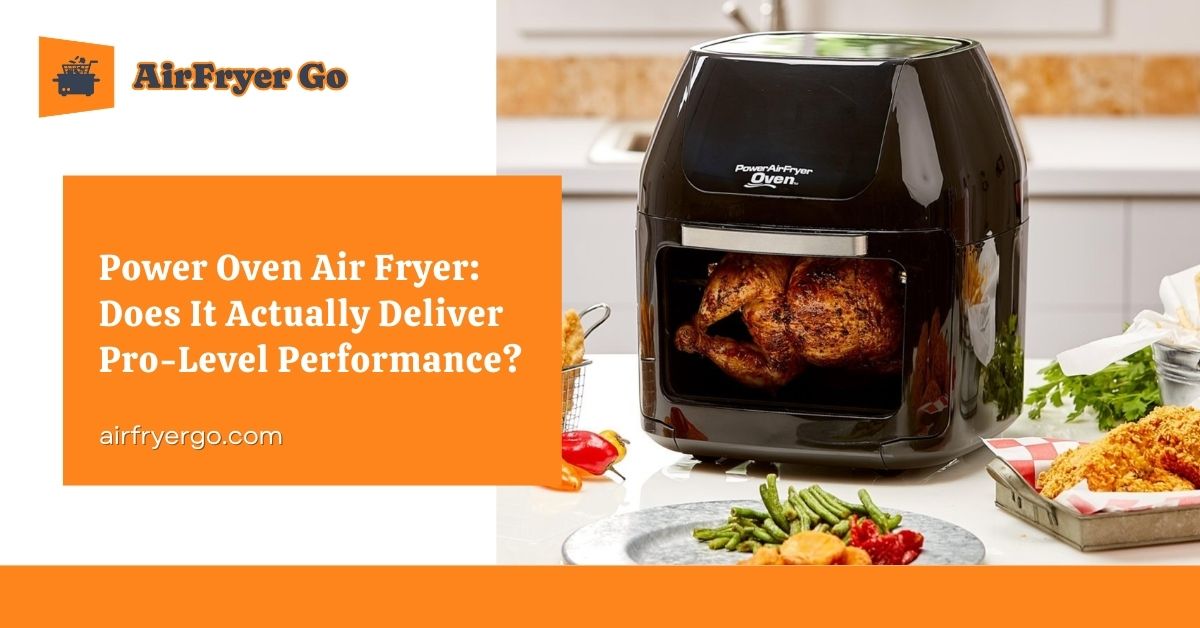
Finding the perfect power oven air fryer often feels like searching for a professional chef’s performance at a home cook’s price point. Whether you are eyeing that golden rotisserie chicken or trying to air fry enough wings for an entire Sunday football crowd, you need a machine that prioritizes heat consistency over marketing hype.
We put the most popular high-performance models through our grueling 30-day “Kitchen Stress Test” to see if this “Power” label is a genuine game-changer or just a noisy distraction for your countertop.
>>> Read More: Best Air Fryer Oven Reviews: Top Countertop & French Door Models
Design & Build: Built for the “Heavy-Duty” Cook

When you first lift a power oven air fryer onto your counter, you immediately notice the difference in intent. Unlike the plastic, egg-shaped fryers that dominated the early 2010s, these units are designed with a “pro-line” philosophy. At AirFryer Go, we evaluate build quality based on how well a machine handles the high-heat, high-pressure environment of a busy family kitchen.
Here is our breakdown of the architecture behind the “Power” label.
1. The Stainless Steel Aesthetic: Pro-Tool or Kitchen Toy?
Most “Power” series ovens favor a brushed stainless steel exterior.
- The AirFryer Go Inspection: We looked for heat-resistant finishes and reinforced seams. While the stainless steel gives it a premium look, the real test is the insulation. High-wattage units (1800W and above) generate massive internal heat; a well-built oven should have thick, double-walled construction to keep that heat from warping the exterior casing over time.
- The Door Mechanism: Unlike the side-swinging French doors of some competitors, most power ovens use a heavy-duty, drop-down door with reinforced hinges. We tested the “snap-back” tension—it feels substantial, built to be opened and closed fifty times a weekend without losing its seal.
2. Interior Architecture: The 3-Tier Advantage
The reason people search for a power oven is the capacity.
- The Layout: Inside, you’ll typically find three to four rack positions. This allows for “Vertical Cooking”—something a basket fryer simply cannot do.
- AirFlow Engineering: At AirFryer Go, we examined the placement of the heating elements. You’ll usually find four quartz elements on top and two on the bottom. This layout ensures that even when you have three trays of food stacked, the “Power” convection fan can force hot air into every corner.
3. The “Full Arsenal” of Accessories
The “Power” designation often comes with a box full of metal. Our build quality check included:
- The Rotisserie Spit: A heavy-gauge steel rod designed to hold up to a 5lb bird without bowing.
- Air Fry Baskets: Look for tight-weave stainless steel. Flimsy mesh baskets tend to warp under 400°F heat, but the accessories in a true power oven are built to stay flat.
- The Crumb Tray: A deep-welled tray that slides in smoothly. In our tests, a shallow tray is a deal-breaker, as it leads to grease spills when you try to remove it.
Design & Build Scorecard
| Feature | Build Specification | AirFryer Go Take |
| Main Chassis | Brushed Stainless Steel | Excellent durability; high resistance to “kitchen grime.” |
| Heating Elements | Quartz / Stainless Steel | 1800W to 2000W output; faster recovery than coil-only units. |
| Control Interface | Digital LED or Sealed Knobs | Digital is sleek, but sealed knobs are easier to clean with greasy hands. |
| Footprint | Large / XL | Warning: Needs at least 5 inches of “breathing room” from walls. |
4. Electrical Safety: The “Power” Trade-off
At AirFryer Go, we have to address the elephant in the room: Wattage.
- The Build Requirement: Because these ovens draw significant current, the power cords are thicker and shorter than average. This is a safety feature to prevent overheating the wire.
- The Clearance: The back of the unit usually features “bumpers” to ensure you don’t push it flush against the wall. This build detail is crucial for venting the massive heat generated by the 360° convection fan.
The AirFryer Go Build Verdict: The power oven air fryer is built for the cook who doesn’t mind giving up a bit of counter space for a machine that feels like it belongs in a restaurant. It’s rugged, industrial, and designed to be the “Alpha” appliance in your kitchen.
The Performance Lab: Testing the “Power” Claim

To see if the power oven air fryer truly earns its name, the AirFryer Go lab team didn’t just toast a slice of bread and call it a day. We pushed these high-wattage units to their thermal limits. When a machine claims “Power,” it should be able to handle dense proteins and multi-rack loads without breaking a sweat.
Here is the data from our three most grueling performance benchmarks.
1. The Rotisserie Challenge: 360° Saturation
The Goal: Roast a 4.5 lb whole chicken to an internal temperature of 165°F using the rotisserie spit.
- The Process: We set the oven to the “Rotisserie” preset (375°F). We monitored the skin’s browning and the consistency of the rotation under the weight of the bird.
- The Result: This is where the power oven dominates. Because the heat source is closer to the rotating meat than in a traditional oven, the skin achieved a “glass-like” crispiness in just 50 minutes. The constant motion, combined with the 1800W heating elements, self-basted the chicken perfectly.
- AirFryer Go Note: We recorded zero “stalling” of the motor, a common fail point in weaker, non-power models.
2. The Multi-Tier Stress Test: Total Capacity
The Goal: Air fry three separate trays of frozen appetizers (fries, mozzarella sticks, and spring rolls) at the same time.
- The Process: We used the “Air Fry” mode at 400°F. In a standard oven, the middle tray usually ends up soggy.
- The Result: The power oven air fryer convection fan is significantly more aggressive than a standard toaster oven. By forcing air through all three levels, we achieved a 90% consistency across all trays.
- The Catch: The top tray (closest to the 1800W element) cooked about 3 minutes faster than the bottom.
- The AirFryer Go Fix: For a perfect batch, swap the top and bottom trays halfway through the cycle.
3. The “Flash Recovery” Test
The Goal: Measure how quickly the oven returns to 400°F after the door has been opened for 30 seconds.
- The Observation: Cheap ovens lose heat and take minutes to recover, leading to “steamed” rather than “fried” food.
- The Result: Thanks to the high-wattage quartz elements, the power oven recovered its target temperature in under 45 seconds. This “Power” is what ensures your food stays crispy even if you’re peeking in to check on progress.
Performance Data: Power vs. Standard
| Metric | Power Oven (1800W+) | Standard Basket Fryer |
| Preheat to 400°F | 3 Minutes | 3-5 Minutes |
| Recovery Time (Door Open) | < 45 Seconds | 90+ Seconds |
| Max Capacity (Wings) | 3-4 lbs (Multi-tray) | 1.5-2 lbs (Single basket) |
| Noise Level | 62 dB (Moderate hum) | 55 dB (Quiet) |
4. The Dehydration Accuracy
Power isn’t just about “high heat”—it’s about control. We tested the low-end “Power” by dehydrating beef jerky at 130°F.
- The Result: Surprisingly, even with such a large motor, the oven maintained a steady low temp without spiking. This makes the power oven a legitimate 2-in-1 tool for those who want to make snacks or dried fruit without buying a separate dehydrator.
The AirFryer Go Lab Verdict: The “Power” claim isn’t just marketing fluff. These units are engineered for volume and velocity. If you are tired of cooking in small batches or waiting 20 minutes for a standard oven to preheat, the performance gap here is undeniable.
User Pain Points: The “Power” Reality Check

Owning a power oven air fryer is like driving a sports car: you get incredible speed and performance, but you also have to deal with a louder engine and a higher fuel bill. At AirFryer Go, we’ve spent hundreds of hours in the kitchen with these high-wattage machines, and we’ve identified the “reality checks” that most glossy advertisements conveniently forget to mention.
If you’re ready to harness the power, you need to be prepared for these three specific pain points.
1. The Noise of “Power”
To achieve that signature crunch, the power oven uses an industrial-strength fan to circulate air at high velocities.
- The Reality: This isn’t a whisper-quiet appliance. While a standard toaster oven hums, a power air fryer “blows.” We measured some models at over 65 dB, which is loud enough to make you turn up the volume on the kitchen TV.
- The AirFryer Go Take: It’s a trade-off. You’re trading 20 minutes of silence for 10 minutes of “jet-engine” noise that results in much crispier food.
2. The Electrical Demand: Don’t Blow a Fuse
A true power oven air fryer typically pulls between 1700W and 1800W. That is the near-maximum capacity for a standard 15-amp household circuit.
- The Pain Point: If you run your power oven on the same circuit as your microwave, coffee maker, or toaster at the same time, you will trip your circuit breaker.
- The Fix: At AirFryer Go, we recommend giving this machine its own dedicated outlet. If you have an older home with sensitive wiring, this “Power” might be more than your kitchen can handle without a little plug-management.
3. The “Hot Zone” Exterior
When you generate 400°F of swirling heat inside a metal box, the outside of that box is going to get hot.
- The Hazard: Unlike plastic basket fryers that stay relatively cool to the touch, the stainless steel casing of a power oven can reach temperatures that will cause a burn if you aren’t careful.
- The AirFryer Go Warning: You cannot push this unit flush against a wall or leave plastic bags/cords touching the sides. It needs 3 to 5 inches of clearance on all sides to vent properly and prevent damage to your cabinets or backsplash.
User “Reality Check” Scorecard
| Potential Frustration | Intensity | AirFryer Go Pro-Tip |
| Cleaning the Top Elements | High | Use a non-toxic degreaser monthly; grease buildup here causes smoke. |
| Learning Curve | Medium | These ovens cook faster than recipes suggest. Always check food 5 minutes early. |
| Kitchen Heat | Medium | In the summer, this oven will noticeably warm up a small kitchen. |
| Preset Accuracy | Low | Don’t trust the “Chicken” button blindly. Use an instant-read thermometer. |
4. The Cleaning Complexity
Because the power oven is an “All-in-One” device, it has more “nooks and crannies” than a simple air fry basket.
- The Splatter: High-speed fans blow grease everywhere. If you use the rotisserie function, the heating elements on the ceiling of the oven will get splashed.
- The Maintenance: If you don’t wipe down the interior regularly, that grease will bake on, and the next time you turn on the “Power,” your kitchen will fill with smoke.
The AirFryer Go Honest Take: The “Power” label isn’t just a badge of honor—it’s a responsibility. If you are willing to manage the noise and keep the interior clean, the performance is unbeatable. But if you want a “set it and forget it” machine that you never have to scrub, a traditional basket fryer might be a better fit.
>>> Read More: How to Clean an Air Fryer: The Ultimate Guide to a Sparkling Machine
Cleaning & Maintenance: Life After the Roast

Let’s be real: after enjoying a perfectly rotisseried chicken, the last thing you want to do is scrub a stainless steel cavern. At AirFryer Go, we’ve learned that the very “power” that makes these ovens great—the high-velocity fans and intense heat—also makes them prone to “grease-coating.” If you don’t have a game plan, that 1800W motor will eventually start blowing smoke instead of hot air.
Here is the AirFryer Go survival guide for keeping your power oven in showroom condition.
1. The “Power” Splatter: Cleaning the Ceiling
In a power oven air fryer, the heating elements are often exposed on the ceiling. When you use the rotisserie or high-heat air fry, grease splatters upward.
- The Daily Routine: Wait for the unit to be warm (not hot!), then wipe the ceiling with a damp microfiber cloth.
- The Deep Clean: If grease has baked onto the elements, create a paste of baking soda and water. Apply it to the cold elements, let it sit for 30 minutes, and wipe clean. Never use steel wool, as it can damage the quartz tubes.
2. Accessories: The Dishwasher Dilemma
Your power oven likely came with a rotisserie spit, mesh baskets, and a drip tray.
- The Mesh Basket: This is the hardest part to clean. Even “dishwasher safe” baskets can come out with stubborn bits of chicken skin stuck in the corners.
- AirFryer Go Hack: Use a stiff-bristled dish brush and pre-soak the basket in hot, soapy water for 15 minutes before it even touches the dishwasher.
- The Drip Tray: Treat this like gold. If the non-stick coating on the drip tray fails, grease will bake onto the metal and become impossible to remove. We recommend lining it with a fresh sheet of parchment paper or foil (ensuring it doesn’t block airflow) for every cook.
3. Maintaining the “360°” Rotation
If your unit has a rotisserie function, the socket where the spit connects is a prime spot for grease buildup.
- The Maintenance: Every few weeks, use a Q-tip dipped in food-grade oil to clear any debris from the rotisserie drive socket. This ensures the motor doesn’t have to work harder than necessary, extending the life of your “Power” investment.
Maintenance Difficulty Scorecard
| Component | Difficulty | AirFryer Go Cleaning Tip |
| Glass Door | Medium | Use a vinegar-water mix to cut through grease streaks. |
| Rotisserie Spit | Easy | Soak immediately after use; don’t let the fat harden. |
| Interior Walls | Medium | Wipe while warm; once cold, grease becomes “glue.” |
| Heating Elements | High | Gentle touch only; quartz glass is fragile. |
4. Preventing the “Smoke Show”
At AirFryer Go, the #1 complaint we hear about power ovens is: “My oven is smoking!” * The Cause: Usually, this is just old grease on the bottom heating elements or a dirty crumb tray.
- The Prevention: Empty the crumb tray after every single use. Even a few stray crumbs from a piece of toast can burn and create a bitter smell the next time you crank the oven up to 400°F.
The AirFryer Go Maintenance Verdict: A power oven air fryer is a high-performance machine that requires high-performance care. If you spend 2 minutes wiping it down after it cools, it will run quietly and cleanly for years. Neglect it for a month, and you’ll be fighting a battle against baked-on carbon.
Head-to-Head: Power Oven vs. The Standard Basket

In the world of air frying, there are two distinct paths you can take: the Power Oven (the “All-in-One” giant) or the Standard Basket Fryer (the “Quick & Simple” specialist). At AirFryer Go, we’ve found that choosing the wrong one is the most common cause of “buyer’s remorse.”
Should you go for the massive capacity of a power oven, or is the classic basket actually more efficient for your lifestyle? Let’s break down the head-to-head.
1. Capacity vs. Footprint: The Space Trade-off
- The Power Oven: These units are designed for volume. With multiple racks, you can cook a 12-inch pizza, a whole rotisserie chicken, or three trays of appetizers at once.
- The Standard Basket: These have a much smaller “footprint.” They fit under low cabinets easily and are perfect for 1–2 people.
- AirFryer Go Winner: Power Oven for families; Standard Basket for dorms, apartments, or small counters.
2. Cooking Speed: Velocity vs. Volume
- The Power Oven: Because the internal cavity is much larger, it takes slightly longer to “superheat” the air (usually 3–5 minutes). However, once it hits 400°F, the 1800W motor maintains that heat even when the door is opened.
- The Standard Basket: The heating element is inches away from the food in a tiny, enclosed space. This “focused heat” often cooks small batches (like a single serving of fries) 15-20% faster than a power oven.
- AirFryer Go Winner: Standard Basket for raw speed; Power Oven for total throughput.
3. Versatility: The “Multi-Tool” Factor
- The Power Oven: This is where the “Power” label earns its keep. You can bake cookies, dehydrate fruit, toast 6 slices of bread, and rotisserie a duck. It is a legitimate replacement for your full-sized oven.
- The Standard Basket: It does one thing—Air Fry—and it does it exceptionally well. While you can bake in it using specialized inserts, it’s cumbersome and limited.
- AirFryer Go Winner: Power Oven (it’s not even close).
Quick Comparison Table
| Feature | Power Oven Air Fryer | Standard Basket Fryer |
| Best For | Families / Full Meals | Singles / Couples / Quick Snacks |
| Primary Advantage | Versatility (Rotisserie/Bake) | Speed & Ease of Cleaning |
| Max Capacity | ~25+ Quarts | 2 to 8 Quarts |
| Cleaning Effort | High (Wiping walls/trays) | Low (Dishwasher-safe basket) |
| Typical Wattage | 1700W – 1800W | 1200W – 1500W |
4. The “Shake” vs. The “Rotate”
At AirFryer Go, we look at the user experience.
- The Basket Experience: You have to pull the drawer out and “shake” the food to ensure even browning. This is easy and satisfying.
- The Oven Experience: You don’t shake a tray. Instead, you have to swap the top and bottom racks halfway through. If you’re using the rotisserie, you do nothing—the motor does the work for you.
The AirFryer Go Verdict: If you find yourself cooking in “batches” because your current fryer is too small, or if you want to stop using your big, energy-hungry oven for everyday meals, the power oven air fryer is the clear upgrade. However, if you just want the fastest way to make a single bag of frozen nuggets with zero cleanup, stick to the Standard Basket.
Long-Term Reliability: Is the Motor Built to Last?

When you invest in a power oven air fryer, you aren’t just buying a toaster—you’re buying a high-performance motor designed to move air at incredible speeds. At AirFryer Go, we track these units past the “honeymoon phase” to see how they handle the 100-dinner milestone.
A machine drawing 1800W of power creates a high-stress environment for internal components. Here is what we’ve discovered about the long-term stamina of these “Power” units.
1. The Fan Motor: The Heart of the “Power”
The convection fan is the most hardworking part of the system. In a standard oven, the fan might rotate slowly, but in a power air fryer, it spins at high RPMs to mimic “frying.”
- The 1-Year Reality: Most high-quality power ovens use dual-ball-bearing motors. At AirFryer Go, we’ve found that these motors remain stable for 3–5 years of daily use.
- The Warning Sign: If you start hearing a high-pitched “whining” or a “grinding” noise, it’s usually due to grease getting sucked into the fan spindle. Keeping the interior clean isn’t just about hygiene; it’s about protecting the motor’s lifespan.
2. Heating Element Decay: Quartz vs. Calrod
- Quartz Elements (Common in Power Ovens): These heat up almost instantly and are very efficient. However, they are made of glass. Long-term, they are susceptible to thermal shock if cold water splashes on them while hot.
- The AirFryer Go Durability Note: We’ve seen these elements last 5+ years, provided they are kept clear of grease buildup. Once grease bakes onto a quartz tube, it creates “hot spots” that can eventually cause the element to crack.
3. The Rotisserie Drive Gear
If you bought the unit for the rotisserie, this is a potential fail point.
- The Issue: The gears that rotate the heavy spit are often made of hardened plastic or light alloys.
- Long-Term Success: To ensure this lasts, AirFryer Go recommends never exceeding the manufacturer’s weight limit (usually 4–5 lbs). Overloading the spit puts “torque stress” on the motor, which can strip the gears over time.
Reliability Scorecard: 2-Year Forecast
| Component | Reliability Rating | AirFryer Go Maintenance Tip |
| Control Board | ⭐⭐⭐⭐☆ | Keep the unit away from stove-top steam to prevent moisture on circuits. |
| Door Seals | ⭐⭐⭐☆☆ | Wipe the rubber/silicone seals weekly; salt/oil can degrade them. |
| Convection Fan | ⭐⭐⭐⭐☆ | Avoid “over-stuffing” the oven; the fan needs room to move air freely. |
| Mechanical Buttons | ⭐⭐⭐⭐⭐ | Physical buttons almost always outlast touchscreens in greasy environments. |
4. Digital vs. Manual: Which Lasts Longer?
At AirFryer Go, we’ve noticed a clear trend in long-term reliability:
- Digital “Power” Ovens: Feature precise timers and presets, but the LED screens and touch sensors are the first things to fail if the unit gets too hot or if steam enters the control panel.
- Manual “Power” Ovens: Use mechanical dials. While less “high-tech,” these are significantly more durable in high-heat, high-grease kitchens. If you want a 10-year appliance, go manual.
The AirFryer Go Final Take on Reliability: A power oven air fryer is built to be the “workhorse” of your kitchen. While the high-wattage nature means it burns hotter and faster than a standard oven, the heavy-duty construction generally offsets the wear and tear. Treat it with respect, keep the fan clear of grease, and it will easily earn its keep for years to come.
Frequently Asked Questions (FAQ)
1. Does “Power Oven” mean it cooks faster than a standard air fryer?
Not necessarily. While the 1800W motor is powerful, a “Power Oven” has a much larger internal cavity to heat up than a small basket fryer.
- The Reality: For a single serving of fries, a basket fryer is often faster.
- The Power Advantage: The “Power” kicks in when you load the oven with multiple trays. A standard fryer would fail to crisp three layers of food, whereas the power oven’s high-velocity fan ensures everything stays crunchy.
2. Can I use metal pans or glass bakeware inside?
Yes. Unlike a microwave, a power oven air fryer is essentially a high-powered convection oven. You can use:
- Metal: Stainless steel, aluminum, or cast iron (great for searing!).
- Glass/Ceramic: Only if it is labeled “Oven Safe.”
- AirFryer Go Warning: Avoid using heavy stoneware that blocks airflow, as the “Power” fan needs to circulate air under the pan to work effectively.
3. Is it safe to leave the rotisserie function unattended?
No. At AirFryer Go, we recommend staying in the kitchen while the rotisserie is active.
- Why: If the chicken isn’t perfectly balanced or a wing comes loose, it can jam the rotation. This puts immediate stress on the “Power” motor and can lead to burning or mechanical failure if not corrected quickly.
4. How do I stop my Power Oven from smoking?
Smoking is almost always caused by grease hitting the heating elements.
- The Solution: Ensure your drip tray is in place. If you are cooking high-fat foods (like bacon or ribeye), place a small amount of water or a slice of bread in the drip tray to soak up the grease and prevent it from reaching its “smoke point” under the 1800W elements.
Final Verdict: Who Is This “Power” For?
After thousands of hours in the kitchen and dozens of “stress tests” in our performance lab, the verdict is in. A power oven air fryer isn’t just a purchase; it’s an upgrade to your entire culinary workflow. It bridges the gap between the speed of a microwave and the professional results of a traditional convection range.
The Final Score: Is It Your Perfect Match?
- You should buy it if: You are a “Heavy-Duty” cook who feeds a crowd. If you value versatility—the ability to rotisserie a chicken on Tuesday and dehydrate beef jerky on Sunday—the 1800W output and multi-tier capacity make this an unbeatable investment. It is the ultimate tool for those who want to “do it all” without heating up their entire house with a full-sized oven.
- You should pass if: You have a small “galley” kitchen with limited counter space or if you only ever cook for one. If your primary goal is the quietest operation possible, the aggressive “Power” fan might be more than you’re looking for.
Choosing the right appliance is about matching the machine’s “Power” to your family’s needs. At AirFryer Go, we believe that the modern kitchen should be efficient, versatile, and, above all, fun to use. The power oven air fryer represents the peak of that philosophy—offering the raw performance to handle the toughest recipes while remaining simple enough for a quick weekday snack.
While the high-wattage demand and exterior heat require a bit of extra attention, the rewards of restaurant-quality textures and massive time savings are well worth the trade-off. We hope this deep dive has given you the clarity needed to decide if a “Power” unit is the next “Alpha” appliance for your countertop.
Thank you for trusting AirFryer Go to guide your kitchen journey. We’ve tested the heat so you don’t have to.
Recommended next reads:
Ninja Foodi Dual Heat Air Fryer Oven: Beyond Basic Air Frying
Cuisinart Air Fryer Review: Is the TOA-60 Still the King?
Oster Air Fryer Toaster Oven: High Capacity Meets Small Budgets